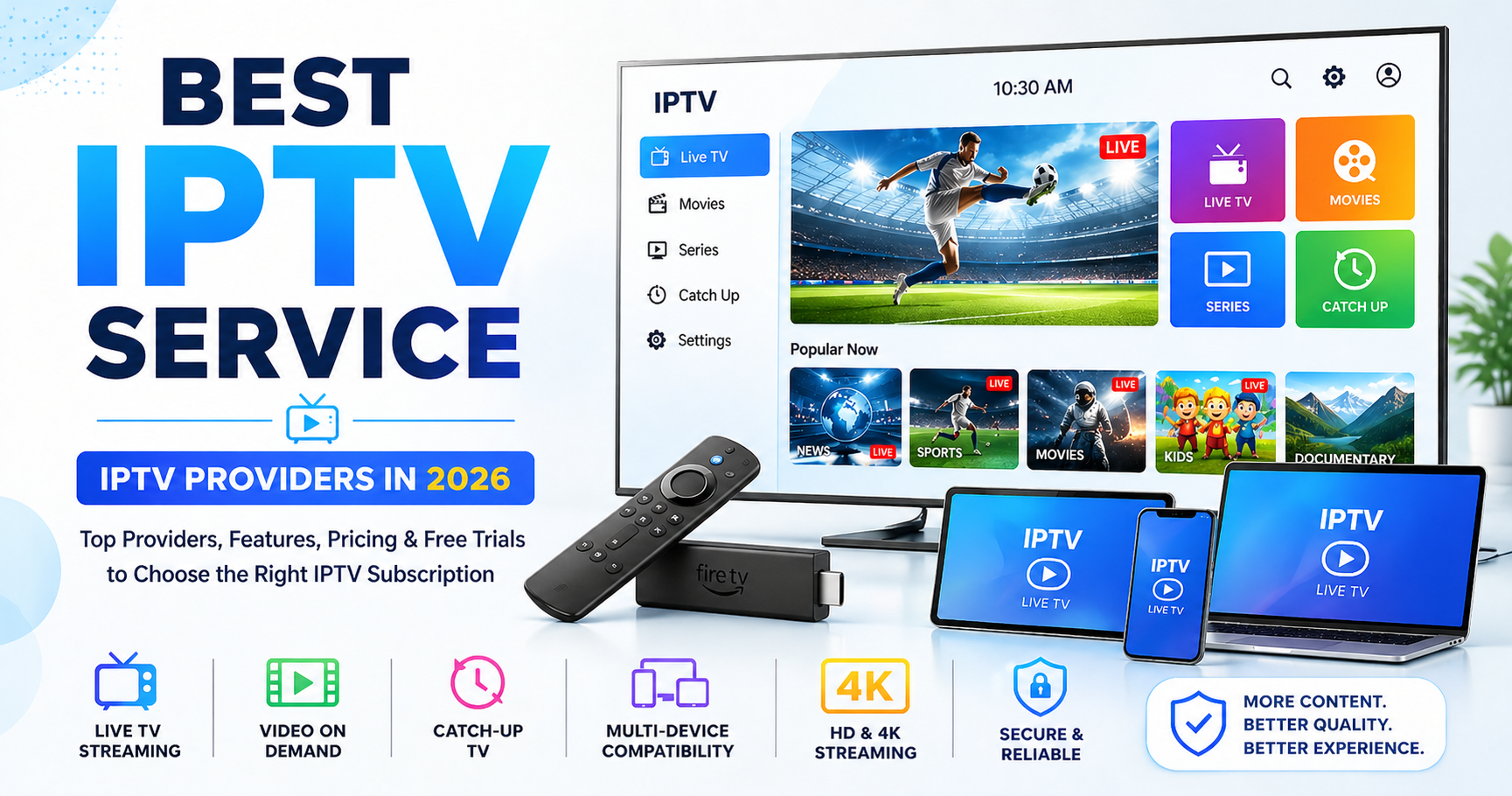
An IPTV service (Internet Protocol Television) delivers live TV channels and on-demand video content over your internet connection rather than through traditional satellite or cable infrastructure. Instead of broadcasting signals to everyone simultaneously, IPTV sends data packets directly to your device, giving you more control, a broader international channel lineup, and often a lower monthly cost than legacy cable bundles. This guide explains the mechanics, the legal landscape, pricing benchmarks, and the exact criteria you should use to evaluate a provider before subscribing.
Whether you are cutting the cord entirely or supplementing an existing streaming setup, the market is saturated with options that range from highly reliable to problematic. The key differentiators are not just channel counts, but server uptime, stream stability, device compatibility, and the quality of customer support. Below, we break down the technical and commercial realities of IPTV so you can make an informed, safe purchasing decision.
iptv service Summary
A reliable IPTV service consolidates live television, sports packages, and VOD libraries into one application, eliminating the need for multiple subscriptions. The most cost-effective providers deliver premium 4K streams with 99.9% uptime at roughly 40% less than the average cable bill.
| Optimal ForCord-cutters and expats seeking international channels without long-term contracts. | Key AdvantageMassive channel variety (10,000+) with anti-freeze technology for stable sports streaming. |
- ✓ Key Strength: Multi-device support (Smart TV, Firestick, Android, iOS, MAG) with instant activation.
- ✓ Key Strength: Global Content Delivery Network ensures minimal buffering during peak hours.
- ✓ Peace of Mind: 24/7 technical support and a 24-hour money-back guarantee for performance issues.
In This Guide
How IPTV Works: The Technical Mechanics
Unlike standard internet streaming (like YouTube) which uses web protocols, IPTV operates on a managed, private network architecture. The provider uses a middleware server to organize content, authenticate users, and deliver streams via protocols like RTSP (Real-Time Streaming Protocol) or RTP (Real-Time Transport Protocol). Your device sends a request to the server, which then transmits the selected audio and video data packets directly to your IP address.
The quality of your experience depends on two primary factors: the provider's server bandwidth and your home connection speed. A reliable service uses a CDN (Content Delivery Network) with multiple servers across regions to reduce latency. For standard definition, you need at least 10 Mbps; for HD, 25 Mbps; and for 4K HDR streams, a stable 50 Mbps connection is recommended. This is why "trial periods" are essential—they allow you to test the infrastructure before committing financially.
The Legal Framework: Licensed vs. Unverified Services
The legality of an IPTV service is determined entirely by its content licensing. A legitimate service (like Hulu + Live TV or YouTube TV) negotiates distribution rights with broadcasters and copyright holders. "Grey market" services, which are often unlicensed, stream content without authorization. While the technology itself is legal, using a service that redistributes copyrighted material without permission violates copyright law in most jurisdictions.
How can you tell the difference? Licensed providers are transparent about their corporate entity, have public-facing privacy policies, and charge rates that reflect licensing fees ($50-$90/month). Unverified services typically offer "lifetime" or absurdly cheap subscriptions ($10-$15/year), require cryptocurrency or untraceable payment methods, and frequently change domains to avoid shutdowns. For a stable, worry-free experience, selecting a provider with transparent operational standards is critical.
IPTV vs. Cable vs. Streaming Apps: Data Comparison
To understand the value proposition, consider how the three primary television delivery methods stack up against the metrics that matter most to consumers: price, content volume, and flexibility.
| Feature / Metric | Traditional Cable | Streaming Apps (SaaS) | IPTV Service |
|---|---|---|---|
| Average Monthly Cost | $80 – $120 | $30 – $70 (stacked) | $10 – $15 |
| Channel Count | 200 – 400 | Varies (Niche) | 10,000 – 20,000 |
| Contract Required | Yes (1-2 years) | No | No (Monthly/Yearly) |
| International Content | Limited Add-ons | Requires Separate Subs | Included |
| Device Compatibility | Set-top box only | Smart TV/Phone | All devices + MAG |
The data indicates that IPTV offers the highest raw volume of content per dollar. However, this value is contingent on the provider's infrastructure quality. A cheap service with poor servers will buffer constantly, rendering the channel count meaningless.
Pros and Cons of IPTV Services
Every delivery method has trade-offs. We have analyzed user reports and industry data to provide a balanced assessment of the IPTV model.
✓ Advantages
|
✗ Limitations
|

Cost-Benefit Analysis and Pricing Tiers
Understanding the pricing psychology of IPTV is essential. Most providers offer tiered subscriptions: 1-month, 3-month, 6-month, and 12-month plans. The monthly equivalent price drops significantly with longer commitments. A typical pricing structure looks like this:
- Monthly: $15 - $20 (Best for testing, highest flexibility)
- Quarterly: $35 - $45 (Good for short-term needs)
- Yearly: $70 - $99 (Best value, often includes extra connections)
For a family or a dedicated sports fan, the yearly plan usually represents the best return on investment. However, we advise against "lifetime" subscriptions. These are financially unsustainable for the operator and often result in the service shutting down within months. Stick to plans that align with the provider's operational overhead—if it sounds too cheap to be sustainable, it likely is.
Buyer's Checklist: How to Choose a Provider
When evaluating an IPTV service, do not be swayed by channel counts alone. Use this technical checklist to vet the provider's quality:
- Request a Trial: A reputable provider offers a 24-hour or 48-hour trial for a nominal fee. This tests server capacity.
- Check the EPG: An accurate Electronic Program Guide is a sign of a professionally managed service.
- Test on Your Primary Device: Performance varies between Firestick, Smart TV, and Android boxes. Test on the device you use most.
- Assess Support Response: Contact support before purchasing. If they take hours to respond, expect the same during outages.
- Verify Payment Security: Ensure the checkout process uses SSL encryption (https://) and offers buyer protection.
The Bottom Line on Iptv Service
If you are looking for a cost-effective way to access a vast library of international content without long-term contracts, a premium IPTV service is the optimal solution. We recommend proceeding with a yearly plan only if the provider offers a trial and demonstrates reliable uptime metrics.
Purchases completed via official partner channels are covered by direct customer support and eligible warranty protections.
Frequently Asked Questions
Is it legal to use an IPTV service?
The legality depends on the provider's licensing. Services that hold distribution rights (like Hulu or YouTube TV) are legal. Unlicensed services that stream copyrighted content without permission are illegal in most jurisdictions. Always verify the provider's licensing status before subscribing.
What internet speed do I need for IPTV?
For standard definition, 10 Mbps is sufficient. For HD streams, you should have at least 25 Mbps. For 4K HDR content, a stable 50 Mbps connection is recommended to prevent buffering. A wired Ethernet connection is always more stable than Wi-Fi for streaming.
Can I use IPTV on multiple devices simultaneously?
This depends on the package. Most providers allow 1 to 3 simultaneous connections. If you have a family, look for plans that explicitly state "multiple connections" or "multi-screen" support to avoid account sharing restrictions.
Will IPTV work on my Smart TV?
Most modern Smart TVs (Samsung, LG, Android TV) support IPTV via native apps like Smart IPTV or TiviMate. Alternatively, you can use a streaming device like Amazon Firestick or Roku, which often provides a smoother experience than built-in TV processors.
What is the difference between IPTV and OTT?
IPTV (Internet Protocol Television) is typically delivered over a closed, managed network with guaranteed bandwidth (like a private ISP). OTT (Over-The-Top) services like Netflix or Hulu use the public internet. IPTV often provides more stable live TV, while OTT excels in on-demand content.
Why does my IPTV keep buffering?
Buffering is usually caused by insufficient bandwidth, high latency, or provider server overload. First, test your internet speed. If your connection is fine, the issue is likely the provider's infrastructure. A reliable service with a CDN will rarely buffer if your connection meets the minimum requirements.
Can I record live TV with IPTV?
Yes, many advanced IPTV apps offer a feature called nPVR (network Personal Video Recorder). This allows you to record live broadcasts to the cloud or your local storage. Check if the provider supports this feature, as it is not universal across all services.
What should I do if my IPTV service goes offline?
If the provider's server is down, wait a few minutes and check their official status page or social media. If it is a permanent shutdown, do not panic. Contact your payment provider for a chargeback if you paid for a long-term plan, and switch to a more established provider with a better track record.
Transparency & Disclosure: We independently evaluate products. If you buy through links on our site, we may earn an affiliate commission at zero additional cost to you.