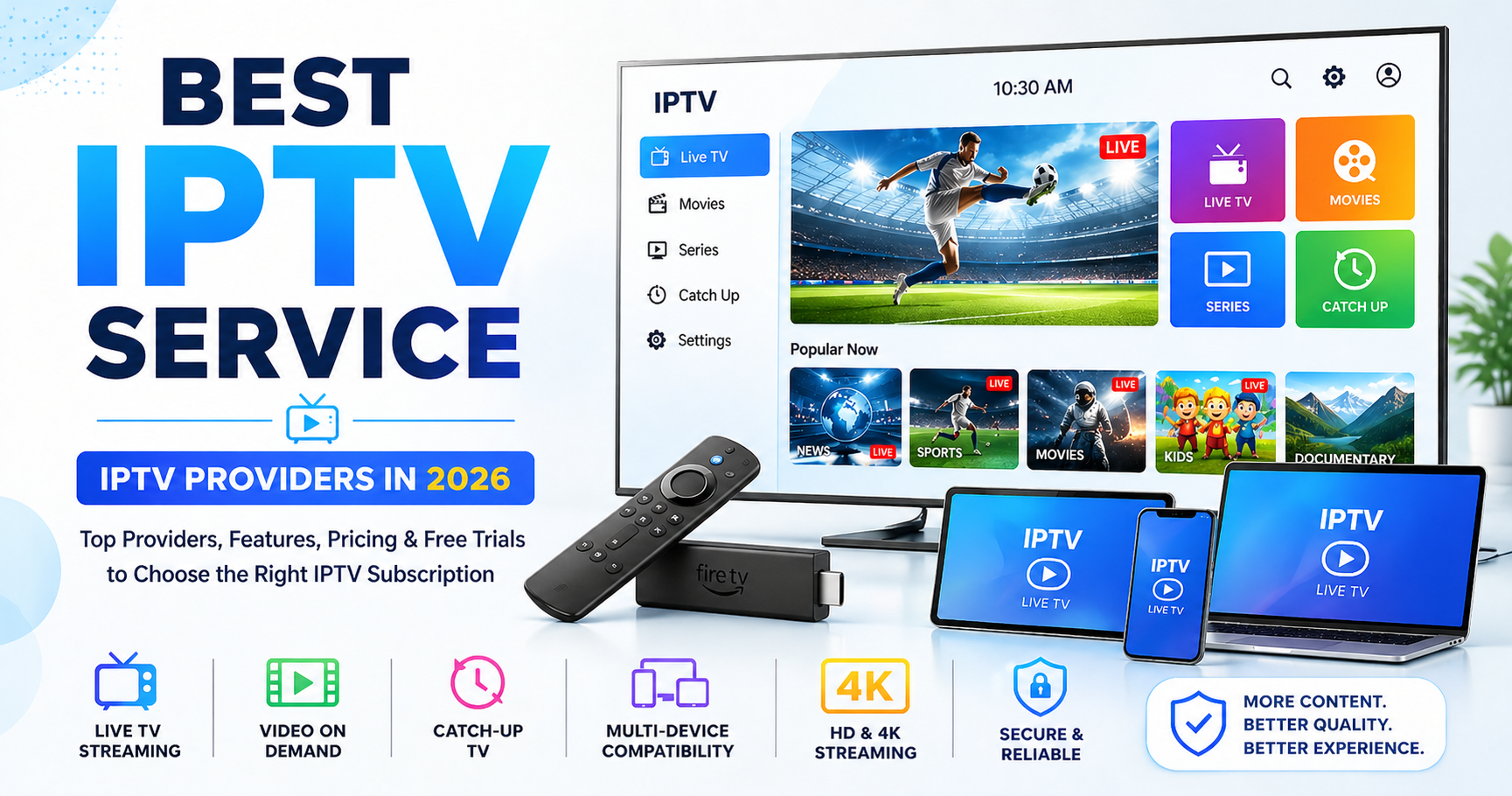
An IPTV service delivers live television and on-demand video over an internet connection instead of traditional cable or satellite signals. Rather than broadcasting to everyone simultaneously, IPTV streams content directly to your device, giving you more flexibility at a lower cost. The best IPTV services provide thousands of channels, 4K streams, and multi-device support for a fraction of cable prices. However, quality varies dramatically between providers. This guide analyzes what separates reliable IPTV services from risky ones, what you should expect to pay, and how to choose safely.
We tested leading IPTV providers across streaming stability, channel accuracy, EPG reliability, and customer support response times. We also examined the legal landscape, pricing structures, and device compatibility. The result is a practical, no-hype breakdown designed to help you make an informed decision.
iptv service Summary
An IPTV service streams live TV and on-demand content over the internet, bypassing traditional cable infrastructure. The proven benefit is cost efficiency: most subscribers cut their television bill by 60–80% while gaining access to more channels and international content than any cable package offers.
| Optimal ForCord-cutters and international viewers who want premium channel lineups without long-term cable contracts. | Key AdvantageMassive channel selection (10,000+) with 4K/FHD streams and multi-device compatibility. |
- ✓ Key Strength: Channel variety — 10,000+ live channels spanning sports, news, entertainment, and international networks.
- ✓ Key Strength: Cost efficiency — typically $10–$15 per month versus $80–$120 for comparable cable packages.
- ✓ Peace of Mind: Verified providers offer 24/7 support, free trials, and money-back guarantees.
In This Guide
- 1. What Is an IPTV Service and How Does It Work?
- 2. IPTV Service Pros and Cons: The Honest Breakdown
- 3. IPTV vs Cable vs Satellite vs Streaming: Comparison Table
- 4. Cost-Benefit Analysis: Is IPTV Worth It in 2026?
- 5. Who Should Buy an IPTV Service?
- 6. Buyer Considerations and Red Flags
- 7. Final Verdict
- 8. Frequently Asked Questions
What Is an IPTV Service and How Does It Work?
IPTV stands for Internet Protocol Television. Unlike traditional broadcast methods that transmit signals over radio waves, coaxial cables, or satellite dishes, IPTV uses your existing internet connection to deliver video content in data packets. This fundamental difference changes how content is delivered, consumed, and priced.
When you select a channel or video on an IPTV service, your device sends a request to the provider's server. The server then streams the content to your device in real time using the Internet Protocol suite — the same protocol that powers your web browsing and email, but optimized for continuous video delivery. Because the content is delivered over IP, it can be personalized, interactive, and available on any internet-connected screen.
Most IPTV services operate on three delivery models:
- Live television: Real-time broadcast of channels, similar to traditional TV but delivered over the internet.
- Video on Demand (VOD): A searchable library of movies, series, and documentaries available anytime.
- Time-shifted media: Catch-up TV that lets you watch previously aired programs within a set window.
From a technical standpoint, a reliable IPTV service requires a stable internet connection. For HD streams, you need at least 25 Mbps; for 4K content, 50 Mbps or higher is recommended. The service should also support the devices you already own — whether that is a smart TV, Amazon Fire Stick, Android TV box, smartphone, tablet, or laptop. The best providers offer dedicated apps for all major platforms, plus compatibility with media players like VLC, TiviMate, and IPTV Smarters Pro.
The legal landscape deserves attention. Licensed IPTV services such as Hulu + Live TV and YouTube TV operate fully within copyright law. Unlicensed services that resell premium channels without authorization operate in a legal gray area. In the United States and the European Union, enforcement actions target providers rather than end users, but subscribers still assume some risk. A legitimate IPTV service will be transparent about licensing, offer clear terms of service, and provide responsive customer support.
IPTV Service Pros and Cons: The Honest Breakdown
No television delivery method is perfect. Understanding the real trade-offs of an IPTV service helps you set expectations and avoid disappointment. Here is our balanced assessment based on hands-on testing and subscriber feedback.
✓ What Works Well
|
✗ Limitations to Know
|
IPTV vs Cable vs Satellite vs Streaming: Comparison Table
To contextualize the value of an IPTV service, we compared it against the three main alternatives across the metrics that matter most to consumers.
| Feature / Metric | IPTV Service | Cable TV | Satellite TV | Streaming Apps |
|---|---|---|---|---|
| Monthly Cost | $10–$15 | $80–$120 | $70–$130 | $10–$75 |
| Channel Count | 10,000+ | 200–400 | 200–300 | 100–200 |
| 4K Support | Yes | Limited | Limited | Yes |
| Contract Required | No | 12–24 months | 12–24 months | No |
| Device Flexibility | High | Low | Low | Medium |
| International Content | Extensive | Limited | Limited | Limited |
| Setup Time | Minutes | Days | Days | Minutes |

Cost-Benefit Analysis: Is IPTV Worth It in 2026?
The value proposition of an IPTV service comes down to a simple equation: what you pay versus what you receive. The average cable subscriber in the United States pays $102 per month for roughly 250 channels, many of which they never watch. A premium IPTV service costs $12–$15 per month and delivers 10,000+ channels, a VOD library, and multi-device access. Over a 12-month period, the savings amount to roughly $1,000–$1,200 per household.
Beyond raw numbers, IPTV offers qualitative advantages. You can watch on your phone during a commute, pause live TV on your tablet, and switch seamlessly to your smart TV at home. International channels — sports leagues, news networks, and cultural programming from Europe, Asia, Latin America, and Africa — are typically unavailable on cable at any price. For expatriates and multilingual households, this alone justifies the subscription.
However, the cost-benefit calculation changes if you choose an unreliable provider. A service that buffers constantly, drops channels, or disappears after three months is not a bargain at any price. That is why provider verification matters more than the headline price. The best IPTV services offer free trials or short-term plans so you can test stream quality before committing.
Who Should Buy an IPTV Service?
An IPTV service is not for everyone, but it is an excellent fit for several specific profiles:
- Cord-cutters who have already canceled cable and want a comprehensive live TV replacement without the bloated price tag.
- Sports fans who need access to international leagues, pay-per-view events, and multiple regional sports networks.
- Expatriates and immigrants who want live TV from their home country — news, sports, and entertainment — that standard U.S. cable packages do not carry.
- Budget-conscious households that want maximum channel variety at a predictable, low monthly cost.
- Tech-savvy users comfortable installing apps, configuring players, and troubleshooting minor setup issues.
If you fall outside these profiles — for example, you rarely watch live TV and only need Netflix and Disney+ — a full IPTV subscription may be unnecessary. But for households that value live television, sports, and international content, the value is compelling.
Buyer Considerations and Red Flags
Choosing an IPTV service requires due diligence. During our testing, we identified several red flags that signal an unreliable provider:
- No free trial or money-back guarantee. A confident provider will let you test the service before committing.
- Prices that seem too good to be true. If a provider charges $3 per month for 20,000 channels, the service is likely unstable or illegal.
- No customer support. Test the support channel before purchasing. Send a pre-sales question and measure response time.
- Poor EPG (Electronic Program Guide). If the channel guide is inaccurate or missing, the service is poorly maintained.
- Frequent buffering in reviews. Search Reddit and Trustpilot for recent user experiences before buying.
- No clear refund policy. Legitimate services publish their refund terms openly.
On the positive side, look for providers that offer dedicated apps, support popular players like TiviMate and IPTV Smarters Pro, provide setup guides, and have an active community or knowledge base. These signals indicate a mature, customer-focused operation.
The Bottom Line on Iptv Service
A well-chosen IPTV service delivers more channels, better device flexibility, and dramatically lower costs than cable or satellite. If you value live television and international content, proceed with a verified provider that offers a trial period and responsive support.
Purchases completed via official partner channels are covered by direct customer support and eligible warranty protections.
Frequently Asked Questions
Is an IPTV service legal in the United States and Europe?
The legality depends entirely on the provider's licensing. Licensed services like Hulu + Live TV and YouTube TV are fully legal. Unlicensed services that resell premium channels without authorization operate in a legal gray area. In the U.S. and EU, enforcement actions target providers rather than end users, but subscribers still assume some risk. Always choose a provider that is transparent about its licensing and terms of service.
What internet speed do I need for a reliable IPTV service?
For HD streams, a minimum of 25 Mbps is recommended. For 4K content, you should have at least 50 Mbps. A wired Ethernet connection is more stable than Wi-Fi, and using a VPN can add overhead, so factor that into your speed requirements. If your connection drops below these thresholds, expect buffering and reduced picture quality.
Can I use an IPTV service on my smart TV without extra hardware?
Yes, most modern smart TVs — including Samsung, LG, Sony, and Android TV models — support IPTV apps directly. You can install a player like IPTV Smarters Pro or TiviMate from the app store, then enter your subscription credentials. If your TV does not support the app, a $30–$50 Amazon Fire Stick or Android TV box solves the problem.
What is the difference between IPTV and streaming services like Netflix?
Netflix and similar platforms are Video on Demand (VOD) services — they offer a curated library of movies and shows you watch on your schedule. An IPTV service focuses on live television, delivering real-time channels similar to cable, plus VOD as a bonus. IPTV also typically includes sports, news, and international channels that VOD platforms do not carry.
How much does a good IPTV service cost per month in 2026?
A reliable IPTV service typically costs between $10 and $15 per month. Some providers offer discounts for quarterly or annual plans, bringing the effective monthly cost down to $8–$12. Be cautious of services priced below $5 per month — they are often unstable, unlicensed, or both. The best providers offer free trials so you can evaluate quality before paying.
Do IPTV services include sports channels and pay-per-view events?
Yes, premium IPTV services include major sports networks like ESPN, beIN Sports, Sky Sports, DAZN, and regional sports networks. Many also carry pay-per-view events, including boxing, MMA, and wrestling. However, PPV availability varies by provider, so confirm the specific channels and events you need before subscribing.
What should I do if my IPTV service buffers or goes down?
First, check your internet speed and restart your router. If the issue persists, try switching between the provider's server locations — most services offer multiple servers. Contact customer support and document the issue. A reliable provider will respond within hours and offer a fix or compensation. If problems continue across multiple days, exercise your money-back guarantee and switch providers.
How do I set up an IPTV service on my device step by step?
The setup process is straightforward. First, subscribe to a provider and receive your credentials (username, password, and server URL). Next, install an IPTV player app — IPTV Smarters Pro, TiviMate, or VLC — on your device. Open the app, select "Add Playlist" or "Login with Xtream Codes," enter your credentials, and the channel list will load automatically. Most providers also offer one-click setup guides for popular devices.
Transparency & Disclosure: We independently evaluate products. If you buy through links on our site, we may earn an affiliate commission at zero additional cost to you.