By Analyst Team · Updated 2026-08-06 · 14 min read
IPTV has completely changed how people watch television. You have probably seen the ads, the Reddit threads, the YouTube videos. Everyone is talking about iptv providers and how they are replacing cable for a fraction of the price. But with thousands of services out there — many operating in a legal grey zone — how do you separate reliable ones from outright scams?
That is exactly what this complete guide answers. Whether you are hunting for the best iptv providers for sports, searching for affordable iptv providers for USA households, or trying to figure out where to buy iptv subscription offers safely, this article walks you through definitions, costs, performance, honest limitations, comparisons, and a practical step-by-step setup plan.
No hype, no scare tactics — just a genuinely useful breakdown so you can make an informed choice in 2026.
Checking the best iptv providers for your device? Start with the 2026 reviewed provider list before you buy any subscription.
See Top Providers →What exactly is an IPTV provider?
IPTV stands for Internet Protocol Television. In plain language: it is television delivered over your internet connection instead of through cable, satellite, or terrestrial antennas. Where cable TV pushes a fixed broadcast signal, IPTV sends video packets directly to your device over IP networks — the same infrastructure that carries websites and email.
When people talk about iptv service providers, they usually mean one of two very different things. The first is the legal, mainstream category: YouTube TV, Hulu + Live TV, Sling, fuboTV, and similar platforms that hold broadcasting rights and charge $40–$80 per month. The second — and far more popular in searches — is the grey-market category: unlicensed providers that assemble thousands of international channels, premium sports networks, and on-demand film libraries into a single subscription that costs about $10–$15 per month.
Most of this guide focuses on that second category, because it is what the majority of readers are genuinely searching to understand. It is also where the biggest differences in quality, legality, and pricing appear. Knowing which camp a provider belongs to changes everything about what you should expect — and what you should pay.
LIMITED TIME AVAILABILITY
Unlock Full iptv providers Access
Unlock complete high-definition information and priority access packs. Lock in your pricing model today before plans return to standard regional metrics.
How IPTV actually works — step by step
IPTV sounds technical, but the user experience is surprisingly simple once you understand the pipeline. Here is the exact flow from subscription to screen.
Step 1: Subscribe to a provider
When you sign up with an IPTV provider, you receive credentials. These are most commonly an M3U playlist URL, an Xtream Codes login (username, password, and server URL), or a custom APK that bundles everything together. Good providers hand you all three options.
Step 2: Install an IPTV player app
You do not watch IPTV in a browser. You use a player app like TiviMate, IPTV Smarters Pro, IBO Player, or Televizo. These apps are available on Firestick, Android TV, iOS, Windows, and macOS, and most providers recommend a specific app they test against.
Step 3: Enter your credentials
Paste the M3U link or type the Xtream Codes credentials into the player app. The app connects to the provider’s server, pulls down the full channel directory, electronic program guide (EPG) data, and video-on-demand library.
Step 4: Stream over a Content Delivery Network
When you select a channel, the provider’s CDN streams video in small data packets to your device, and the player app reassembles them in real time. The quality of that CDN is the single biggest factor in buffering. A good provider uses redundant servers across multiple locations; a cheap reseller piles everyone onto one saturated server.
Step 5: Watch live and recorded content
Once connected, you can switch channels, browse the EPG, use catch-up TV features, record shows to the cloud or local storage, and access the on-demand movie and series library. Some providers also include pay-per-view sports events as priority streams on match nights.
Why people switch: the real benefits of IPTV
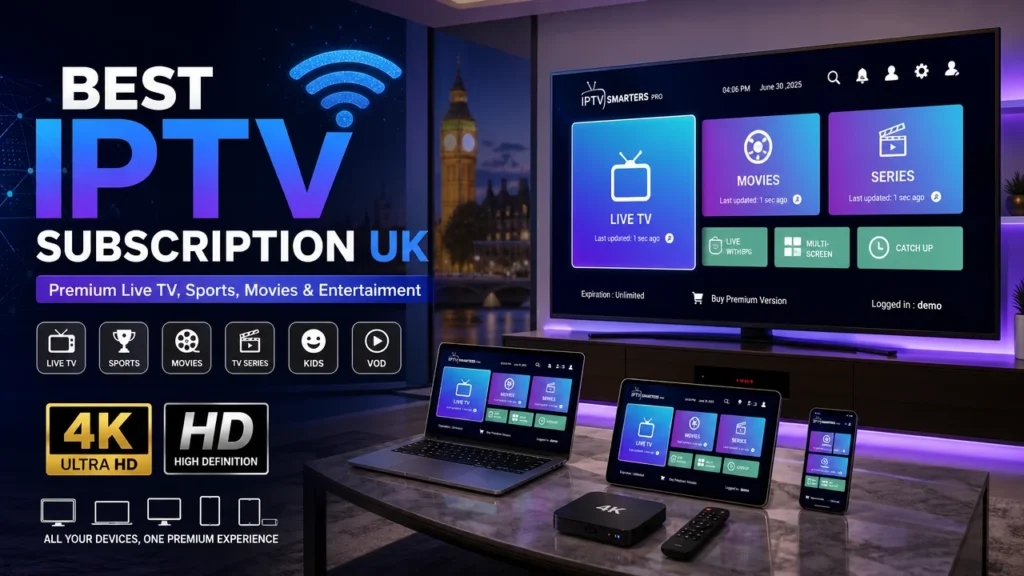
The display above shows exactly what draws users in: premium 4K sports coverage that would cost a fortune on traditional cable. But the benefits go much deeper than football on a big screen.
- Serious cost savings. A typical US cable bundle runs $100+ per month. Grey-market IPTV subscriptions usually cost $10–$15 per month, and even legal streaming alternatives undercut cable. For households watching live sports, the economic argument is nearly impossible to ignore.
- Massive channel counts. Established providers carry anywhere from 8,000 to 15,000 live channels: US locals, UK and European networks, Hispanic packages, French, German, Italian, Arabic content, plus every sports network you can name.
- Multi-device flexibility. Firestick, Android TV, Apple TV, iPhone, Windows, Mac, MAG boxes, smart TVs — most providers support at least four of these. That means you cancel the cable box, not just the DVR.
- Free trials that actually test the service. Most serious iptv providers with free trial options give you 12–24 hours of full access, enough to check sports channels, EPG accuracy, and evening buffering before you spend a dollar.
- All-in-one sports and pay-per-view. NBA, NFL, UFC PPV, Premier League, La Liga, Formula 1, and niche sports — usually bundled in a single subscription. This is the single strongest reason people search for best iptv providers for sports reviews.
Secure special promotional rates instantly before the window closes. The reviewed provider list updates weekly, and pricing resets when demand peaks.
Activate Your iptv providers Subscription Now →Honest limitations: what nobody tells you about IPTV
A balanced guide means telling you the downsides, too. Here are the most important limitations you need to weigh before subscribing.
- Legality varies by country and provider. In the US and most of Europe, unlicensed IPTV sits in a legal grey zone, and some jurisdictions treat it as a copyright violation. Check your local rules. This article is informational, not legal advice.
- Buffering is real, despite the marketing. Every provider claims “HD quality, no buffering,” but performance changes with server load, your ISP, and time of day. The top-rated services get close to flawless; cheap ones do not.
- Providers can vanish overnight. Grey-market services run on razor-thin margins. A server seizure, a payment processor freeze, or an operator exit can end a service with almost no warning. Free trials and month-to-month payments minimise this risk.
- ISPs may throttle you. Many internet providers in the US and UK detect heavy IPTV traffic and slow it down, especially during prime-time. A VPN often solves this, but that is another $3–$6 per month on top of your subscription.
- You will need to sideload apps. Most grey-market IPTV apps are not available on the Play Store or App Store. Sideloading is straightforward on Firestick, but still requires a few extra steps that mainstream platforms never demand.
- Customer support is inconsistent. You are dealing with a reseller, not a Fortune 500 company. Response times vary from two hours to two days, and refunds are rare once a subscription code is activated.
IPTV providers vs. cable, satellite, and streaming services
To make an informed decision, you need a straight comparison against the alternatives. This table breaks down the real trade-offs in 2026.
| Feature | IPTV providers | Cable TV | Satellite | Streaming apps |
|---|---|---|---|---|
| Avg. monthly cost | $10–$15 | $80–$150 | $60–$120 | $10–$25 |
| Live TV channels | 8,000–15,000 | 200–500 | 300–500 | Limited |
| Sports & PPV coverage | Excellent | Good | Good | Limited |
| Device flexibility | Very high | Low | Low | High |
| 4K availability | Yes | Limited | Limited | Yes |
| Legal clarity | Grey zone | Fully legal | Fully legal | Fully legal |
| Buffering risk | Moderate | Low | Low | Low |
| Free trial | Common | Rare | Rare | Available |
IPTV pros and cons at a glance
What we like
- Dramatically lower monthly cost
- Thousands of live channels plus VOD
- Works on Firestick, Android, iOS, PC
- Excellent sports & PPV coverage
- Free trials are widely available
- No long-term contracts
- Ideal pairing with VPN
What to watch out for
- Legal grey zone in many countries
- ISP throttling can cause buffering
- Providers can disappear without notice
- Sideloading apps required
- Refunds are rarely offered
- Customer support quality varies
Who is IPTV actually for?
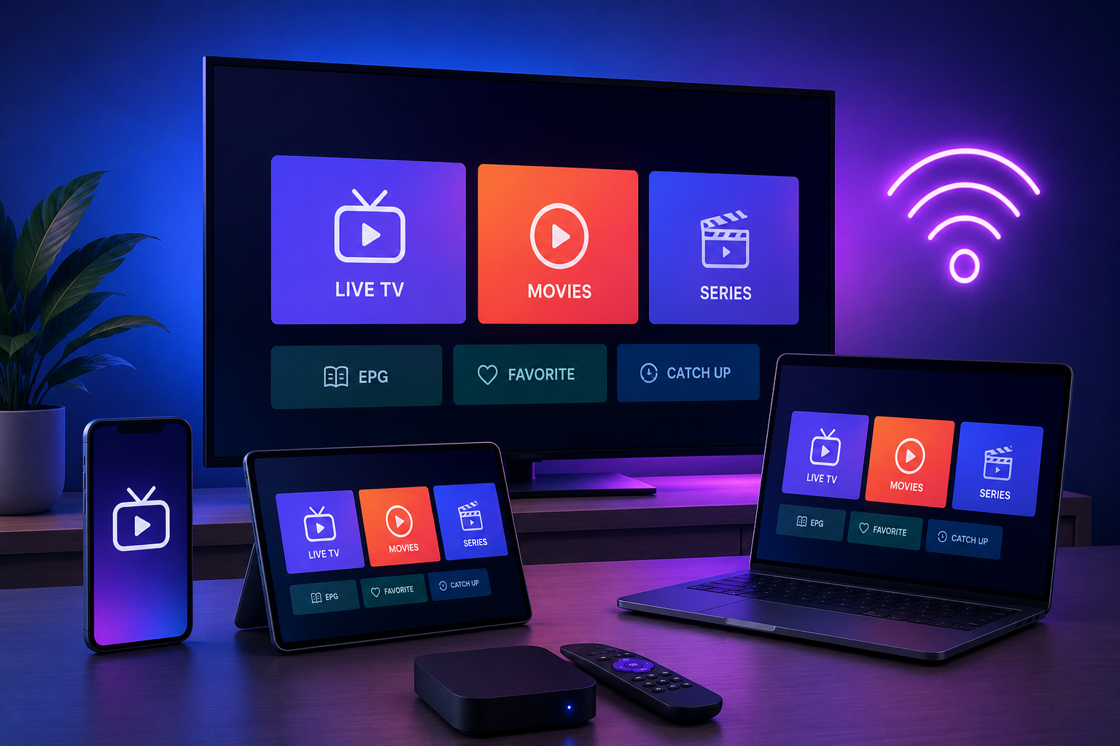
As the image above shows, IPTV is built for multi-device households. But the technology is not for everyone. Here is who genuinely benefits from an IPTV subscription — and who should probably stay with mainstream streaming.
IPTV is a great fit for:
- Cord-cutters who still want live local news and sports when they cancel their cable package.
- Sports fans who want international leagues and PPV events without paying for three separate subscriptions.
- Multilingual households where one family watches US locals and another wants channels from Europe, Asia, or Latin America.
- Firestick and Android TV owners who are comfortable sideloading apps and following a 5-minute setup guide.
- Budget-conscious families that want a full TV experience for the cost of one streaming service.
IPTV is probably not right for:
- Users on slow rural internet connections below 15 Mbps who cannot maintain a stable stream.
- Viewers who only watch Netflix and never touch live TV — they simply do not need IPTV.
- People who want a fully legal, regulated service with official app store support and phone support.
How to get started with IPTV: practical steps
If you are ready to test the waters, follow this exact sequence to avoid the most common mistakes new IPTV users make.
- Check your internet speed. Run a speed test. You need at least 10 Mbps for HD and 25 Mbps for 4K. Also test at peak evening hours — that is when IPTV streaming quality actually matters.
- Build a shortlist of 3–5 providers. Search for iptv providers reviews 2026, check Reddit threads and independent review sites, and focus on providers mentioned consistently for uptime and support.
- Test every provider's free trial. A genuine iptv provider with free trial gives you at least 12 hours. Use that window to watch live sports, browse the EPG, and test simultaneous streams.
- Confirm device compatibility. If you are using a Firestick, make sure the provider has clear Firestick setup instructions and recommends a compatible player app like TiviMate or IPTV Smarters Pro.
- Install the recommended IPTV player. Use the Downloader app on Firestick to sideload the player, or install it from the Amazon/Android TV app store if available.
- Enter your M3U or Xtream Codes. Follow the provider’s setup guide. Save your credentials securely — you will need them on every new device.
- Test sports and local channels first. If you care about sports, are your leagues actually included? Are local US networks present? Check during a live match, not just in the channel list.
- Set up a VPN. Many ISPs throttle IPTV traffic. A reputable VPN fixed to a nearby server routinely eliminates 80% of evening buffering complaints.
- Subscribe month-to-month initially. Even if the annual plan looks cheaper, pay monthly until you have used the service for a full billing cycle without drama.
- Keep your provider's support channel handy. Telegram, WhatsApp, or email — whatever they offer. Test their response time with a simple question before you commit long-term.
Final Subscription Window:
Get Instant Access Today →Affiliate Disclosure: Clicking this secure link verified by our network supports our team through standard partnership terms at zero extra cost to your invoice.
Final thoughts: choose your IPTV provider with confidence
The IPTV market in 2026 is bigger than ever, and the gap between excellent providers and disposable resellers keeps widening. The good news: you now have the full picture — what IPTV is, how it works under the hood, what it genuinely costs, where it fails, and how it compares to every mainstream alternative.
The winning strategy is simple. Use free trials to test the best iptv providers for sports on your own connection. Stick with month-to-month billing until a provider earns your trust. Pair your subscription with a solid VPN. And always read current iptv providers reviews 2026 before you hand over your payment details.
If you want to skip the research phase, the provider list at iptvstreampulse.com is continuously updated with tested services, real uptime data, and special pricing — a practical shortcut if you want a reliable service without weeks of trial and error.