By Marcus T. · Updated 2026-08-15 · 13 min read
You sit down for the big match, press the power button on your iptv box, and the screen lands on a buffering spinner that never stops. Or the box boots, shows your channel list for a few seconds, then freezes the moment you open a live channel. If you have already tried the standard advice — restart, unplug, reinstall — and nothing changed, you are not alone.
An iptv box that is "not working" is rarely broken. In most cases, the problem is a combination of predictable factors: a weak network path, a misconfigured player app, an underpowered device, or a subscription feeding the box from an overloaded server. Once you identify which factor you are dealing with, most fixes take minutes, not days.
The setup shown above covers the whole failure zone in one glance: box, screen, router, service. This guide walks through the three most common mistakes people make with an iptv box, why the usual fixes fail, and the exact steps experienced users take to get a stable picture — especially for live sports, where IPTV problems are easiest to spot.
The Three Most Common Mistakes with an iptv box
1. Relying on congested Wi-Fi
Most iptv boxes default to the 2.4 GHz Wi-Fi band, which is also used by cordless phones, baby monitors, microwaves, and every other device in your home. Even when your internet plan is fast, Wi-Fi interference causes jitter and packet loss — and live streams freeze instantly. You notice it first on sports channels, which use higher bitrates than talk shows or movies.
2. Using the default player without adjusting the settings
Out-of-the-box players prioritise simplicity over reliability. Buffer size is usually tiny, hardware decoding might be switched off, and audio settings are preconfigured for a cheap soundbar. The result is a stream that stutters, audio that falls out of sync, or a screen that goes black for a second every time the buffer empties. These settings are made to be changed.
3. Pairing the wrong subscription with the wrong box
An iptv box is only as good as the service it connects to. A bargain subscription with ten thousand channels and one support person will not survive a Sunday sports rush. The same applies to hardware: a $30 box with 1GB RAM and no hardware 4K codec cannot deliver a smooth 4K feed no matter how fast your internet is. When people buy the cheapest box and the cheapest subscription, they blame the entire setup when it fails.
Why the Usual Fixes Don't Work
"Restart the iptv box" works when an app has crashed. It does nothing when the root cause is a congested Wi-Fi channel, a provider that ran out of bandwidth, or a player with the wrong decoder settings. A factory reset is more dangerous: it returns the box to the same broken defaults and wipes the settings that would have fixed the problem.
People then try changing the router, buying a new HDMI cable, or upgrading to a faster internet plan. Sometimes that helps. Most of the time it is wasted effort because the test was done on the wrong device — usually a phone, not the box itself. Experienced users never guess; they isolate the problem first.
What Experienced Users Do Differently
Instead of restarting and hoping, they check each layer of the chain in order: network, player, box memory, then subscription. Here is what that looks like in practice:
- They test the network on the box itself, not on a phone. A phone connected to Wi-Fi can show 80 Mbps while the box two metres away sees half of that because of a weak antenna.
- They wire the box when possible. Ethernet cables cost very little and eliminate Wi-Fi dropouts completely. If the box lives in another room, they use a powerline adapter or deliberately move it to the 5 GHz band.
- They configure the player for a larger buffer, hardware decoding, and a 60fps refresh rate. This single step resolves more freezing issues than any other.
- They verify the provider separately. A quick trial with a known-good service tells you within an hour whether the box is fine and the subscription is the problem.
This is also how the question of the best iptv box for live sports should be answered. Experienced buyers do not look for the biggest channel count. They look for 2GB+ RAM, a quad-core chip that handles 60fps, and a box that supports wired Ethernet. Most practical 4k iptv box review guides agree on those two specs — H.265 codec support and at least 2GB of RAM — and ignore everything else a glossy box claims.
As for the iptv box vs firestick debate: a dedicated iptv box wins for live TV when you need an Ethernet port, USB storage, and a device that is not tied to one storefront. The Firestick is simpler to travel with, but its Wi-Fi-only design makes it the weaker choice for a fixed setup in a busy household.
Pros and Cons of a Dedicated iptv box
✓ Benefits & Pros
Dedicated hardware handles 4K and 60fps sports streams more reliably than a general streaming stick.
Wired Ethernet support removes the most common cause of buffering.
Player flexibility: you can install multiple IPTV apps and tune every performance setting.
Usually works fine with iptv box subscription no contract plans because there is no locked storefront.
✗ Limitations & Cons
Setup takes longer than plugging in a streaming stick; you are expected to configure the app stack.
Quality depends heavily on the provider and the app you choose — not just the hardware.
Grey-market sellers label cheap boxes as "4K HDR" when the chipset does not support it.
Every manufacturer updates their firmware on a different schedule, so long-term support is inconsistent.
RECOMMENDED RESOURCE
iptv box
If you want a service that supports live sports, 4K playback, and multiple TV connections, compare the current lineups and pricing in one place.
Check Out iptv box Deals →
Live sports places the harshest demand on any iptv box: the picture above combines the match feed, the score overlay, and the program guide, and every layer has to arrive in sync. When one layer drops, you get a frozen frame or a stutter. That is why the repair steps below start with the network instead of the device.
The Step-by-Step iptv box Fix
Step 1 — Confirm the box is actually alive. Check the LED, the power brick, and the HDMI cable. A black screen with a lit LED usually means the HDMI port is wrong or the cable is loose. Swap the cable before you blame the app.
Step 2 — Run the speed test on the box, not on your phone. Open the box's browser and run a speed test. For 4K you need at least 25 Mbps, and for live sports the bitrate should be stable. If the box reports a high download but the ping jumps around, the Wi-Fi is the problem.
Step 3 — Free up storage and memory. Go to Settings → Apps, force-stop the IPTV app and any background apps. Delete leftover APK files. A box that is nearly out of storage starts to crash and buffer for no visible reason.
Step 4 — Configure the player app. In the player settings, set the buffer size to 4–8 MB or "large". Enable hardware acceleration and hardware decoding. If the app has an option for 60fps or real-time playback, turn it on. Restart the player and test a channel.
Step 5 — Change the DNS server. If channel lists load slowly or the box loses connections, manually set DNS to 1.1.1.1 or 8.8.8.8 in the network settings. This often solves loading issues that look like a broken subscription.
Step 6 — Do a single, clean factory reset. If the box is still unstable, do one factory reset and reinstall only what you need: your player app and your subscription app. Install them from official sources. Do not restore old backups — the whole point is to clear corrupted settings.
Step 7 — Isolate the subscription. Start a short trial with a different provider. If the trial works on the same box and network, your current subscription is the weak link. Many people discover that their hardware was fine all along.
Step 8 — Watch the temperature. If the box is hot to the touch, its Wi-Fi and CPU performance drop. Keep it in an open spot, remove anything covering it, and if heat is a constant issue, add a small USB fan.
Realistic Results After the Fix
These steps fix the common cases, not every case. After a proper network check and player configuration, you should see channel switching drop to 2–4 seconds, 4K streams stop refreshing every few minutes, and live sports hold a stable frame rate during fast movement.
But if your internet plan is below 25 Mbps, your router is several years old, or your chosen provider is consistently oversold, no box configuration will deliver a perfect picture. The box is one part of a chain — the network and the subscription are the other two. That honesty is missing from most iptv box guides.
Pitfalls to Avoid
- Free IPTV apps from random blogs. Most are bundled with adware or worse that causes more freezing and exposes your data. Install apps only from the official store or the developer's own feed.
- Blaming the box before testing the network. If the same box plays smoothly on a trial subscription or a different app, the hardware is not the problem.
- Using the wrong power adapter. A weak adapter under 1.5A causes random reboots and freezes. Use the original adapter that came in the box.
- Buying the cheapest box for a serious setup. A cheap iptv box with wifi can handle casual viewing, but if you want 4K channels or live sports, spend a little more on a recognised chipset and 2GB+ RAM.
- Running one box for multiple TVs. Splitting HDMI means both screens show the same channel and often freeze because the single output struggles — that is not an iptv box for multiple tvs, it is a bad evening waiting to happen. Each TV needs its own box and its own clean network link.
What Works vs. What Does Not
If you have followed the table above and still suspect the subscription side, compare the server quality and package options of the top-rated iptv box services side by side.
View the iptv box Platform →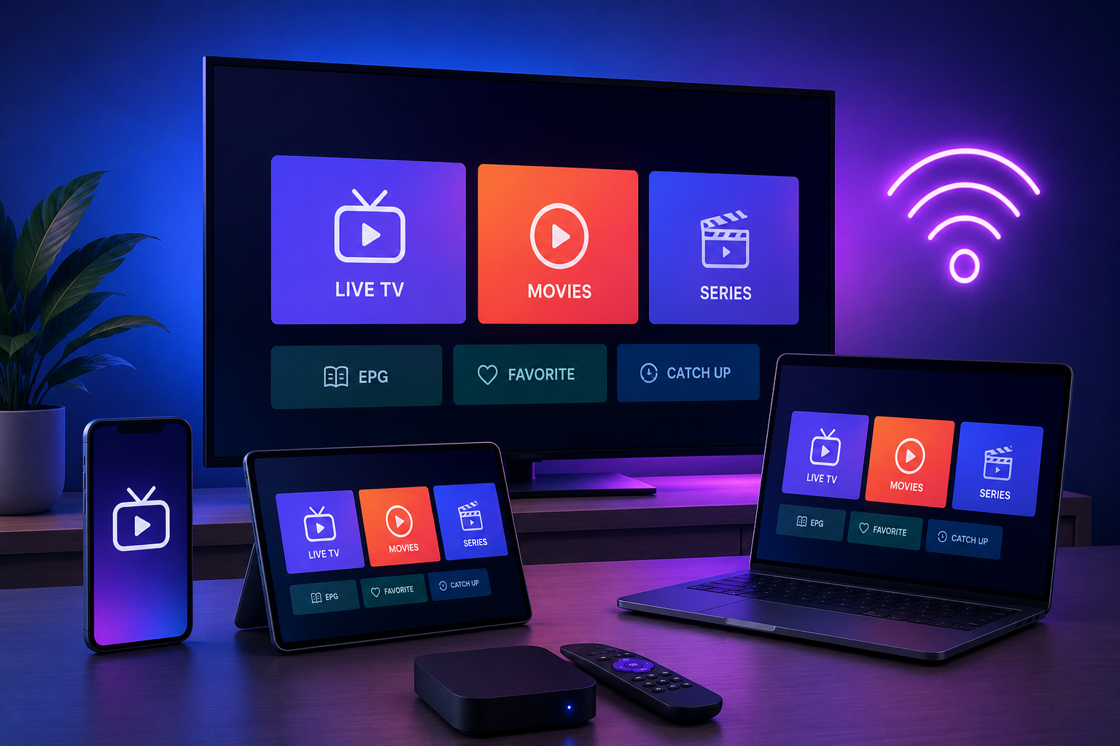
The image above reflects the cleanest setup: one dedicated box per screen. If you have a multi-TV household, plan for that from the start — the wiring and router placement matter more than any brand name. And when you work out the total number of devices, you can also answer the question of where to buy iptv box hardware with confidence: buy from a supplier who clearly lists the chipset, RAM, and network ports, and avoid sellers who only advertise "4K" and "10,000 channels".
The Bottom Line
An iptv box that is not working is usually a configuration problem, not a hardware failure. Work through the fix in order: network, player settings, storage, then subscription. If the issue appears mainly on live sports, the bottleneck is almost always the path between the provider and your screen.
Experienced users get a stable setup by wiring the box, tuning the player, and choosing a subscription with real server capacity. Apply the steps in this guide and you will have a working iptv box by the end of the evening — no guesswork needed. If you want to compare services and hardware offers quickly, the link below collects the current options in one place.
Featured Streaming Selection:
Find Out More About iptv box →Affiliate Disclosure: Clicking this secure link verified by our network supports our team through standard partnership terms at zero extra cost to your invoice.
Frequently Asked Questions
This article contains affiliate links. Our editorial analysis remains independent.